 100% Canadian Created
$29.99/mo, all 26 courses
Cancel anytime

Course 2: Residential Real Estate Transactions Study Guide
Focuses on representing buyers and sellers in residential transactions. Covers the Agreement of Purchase and Sale, working with clients, showing properties, and completing standard residential offers.
1 of 26 courses included in your $29.99/mo plan · See all 26
Try a sample question
This is the difficulty and format you'll see in the Course 2 practice bank. Pick an answer and read the explanation.
Try this practice question
A buyer submits an offer with a financing condition expiring at 11:59 PM Friday. On Friday at 4 PM, the buyer's lender confirms approval verbally. The condition is:
Pick an answer to see the explanation. The real product gives you AI follow-up on every question.
Key terms in Course 2
Plain-English definitions of the terms tested most heavily in this course. Each links to a deeper write-up with examples and exam scenarios.
Agency Relationships
The legal and ethical structure governing how a real estate registrant represents a client. Under Ontario's TRESA, agency takes specific forms — seller representation, buyer representation, multiple representation, and designated representation — each with distinct fiduciary duties.
Agreement of Purchase and Sale
The legally binding contract under which a buyer and seller agree to a real estate transaction in Ontario, capturing price, deposit, conditions, irrevocability, and closing terms. The standard residential APS is OREA Form 100.
Buyer Representation Agreement
A written contract between a buyer and a real estate brokerage that establishes the brokerage as the buyer's representative under TRESA. Defines the duration, geographic area, commission, and the duties the brokerage owes the buyer. The standard Ontario form is OREA Form 300.
Caveat Emptor
Latin for 'let the buyer beware': the common-law principle that a buyer of real estate is responsible for inspecting and confirming the property's condition, subject to the seller's narrow duty to disclose latent defects.
Chattels vs Fixtures
Chattels are movable items of personal property (fridge, washer, dryer, microwave) that do not stay with the property unless specifically included in the Agreement of Purchase and Sale. Fixtures are items attached to the land or building that stay with the property by default unless specifically excluded.
Closing Costs (Ontario)
The fees, taxes, and adjustments a buyer pays on top of the purchase price when an Ontario real estate transaction completes. Typically 1.5% to 4% of the price, comprising land transfer tax, legal fees, title insurance, adjustments, and disbursements.
Conditional Offer
An Agreement of Purchase and Sale that includes one or more conditions (financing, inspection, status certificate review) that must be fulfilled or waived within a stated period before the offer becomes binding. The buyer can walk away if a condition fails, with deposit returned.
Land Transfer Tax (Ontario)
A provincial tax payable by the buyer on the closing of any Ontario real estate purchase, calculated as a marginal rate on the purchase price. Toronto purchases also pay a separate Municipal Land Transfer Tax with similar brackets.
Latent Defects
Hidden defects in a property that are not discoverable on a reasonable inspection but that the seller knows or ought to know about. Sellers have a duty to disclose latent defects that make the property dangerous or unfit for habitation, and the duty overrides the default caveat-emptor rule.
Misrepresentation
A false statement of material fact that induces a party to enter into a real estate contract. Under Ontario law, misrepresentation can be innocent, negligent, or fraudulent — and each type carries different remedies.
OREA
The Ontario Real Estate Association: a member-based trade association that publishes the standard transaction forms used in Ontario real estate and advocates for the profession. OREA is not a regulator and no longer delivers pre-registration education.
Patent Defects
Visible flaws in a property that a reasonably prudent buyer would discover on a normal inspection: cracked tiles, peeling paint, broken windows, sagging gutters. Sellers do not have a duty to disclose patent defects under Ontario's caveat emptor rule, though they cannot actively conceal them.
Right of First Refusal
A contractual clause giving a specific party (often a tenant, family member, or condo neighbour) the right to match any bona fide third-party offer to purchase a property before the owner can sell to that third party. Triggered when a bona fide offer is received.
Title Insurance (Ontario)
A one-time premium insurance policy that protects an Ontario property owner and their lender against losses arising from defects in the title, undisclosed encumbrances, fraud, and certain off-title issues. Standard coverage is roughly $300-500 for a typical residential purchase.
See the full Ontario real estate glossary.
Your study experience
Everything you need to pass, practice questions, AI explanations, spaced repetition, and progress tracking.
Under TRESA, when must a salesperson disclose a material latent defect?
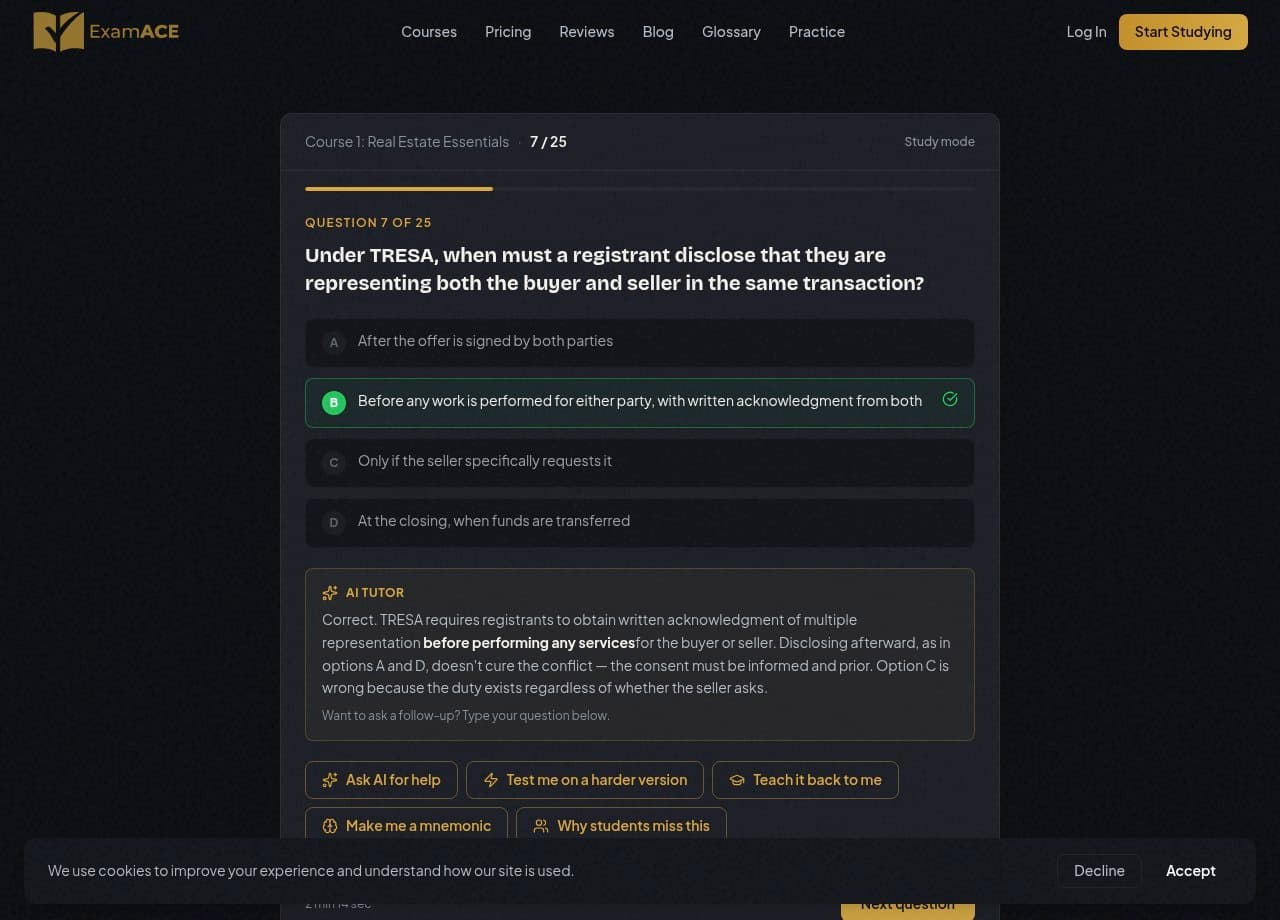
Ask unlimited follow-ups on any question. Passit gives you a static explanation and stops there.
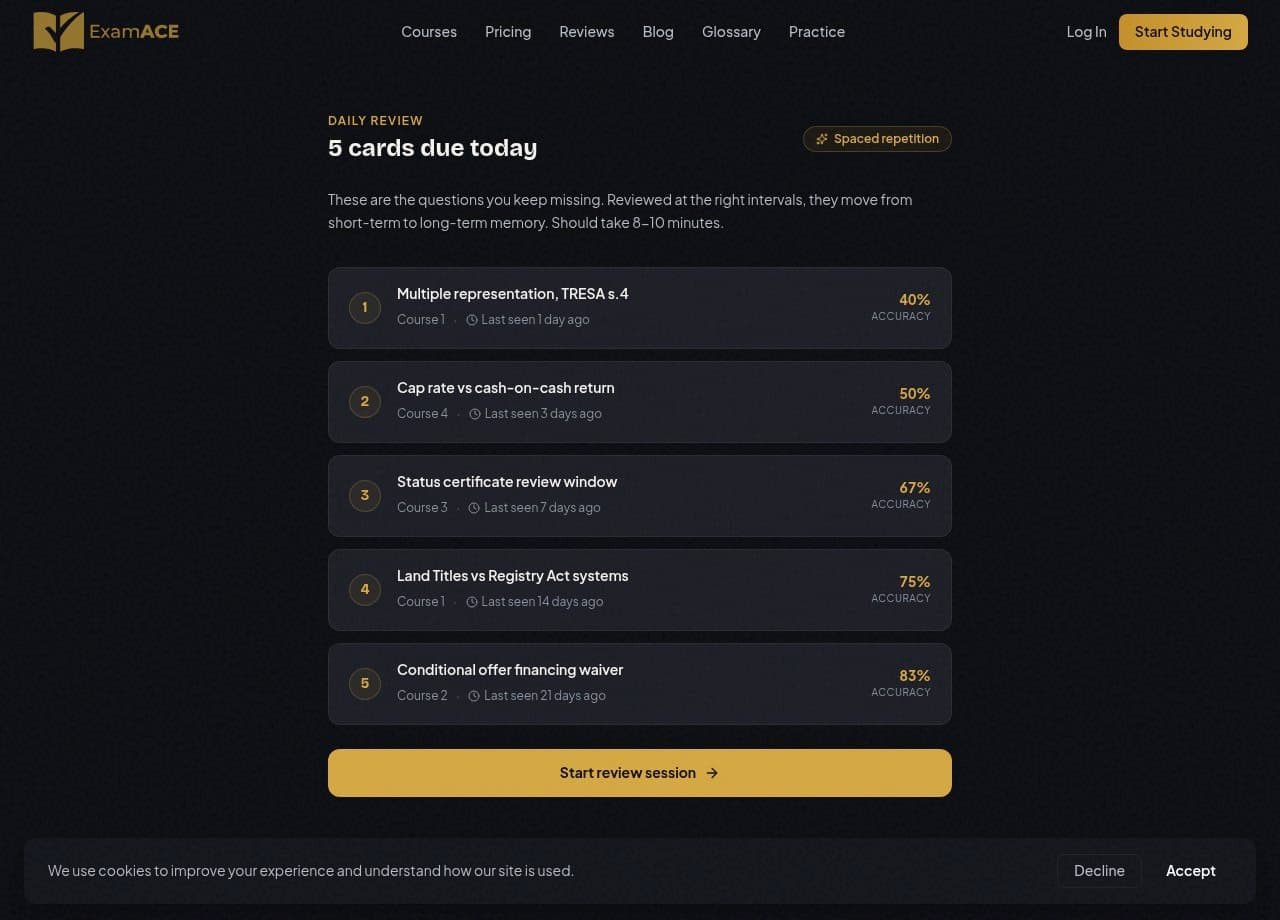
The SM-2 algorithm resurfaces questions you got wrong at the exact moment before you would have forgotten them.
Topics mastered
8 of 12
Weakest area
Land Registration
6 topics · 6 study guides
Every topic comes with a written study guide
Each topic below includes a plain-English summary of the textbook material, the key rules and definitions, worked math examples where applicable, and the exam-style traps that catch first-time candidates. Read on desktop or on your phone, anywhere you have a few minutes.
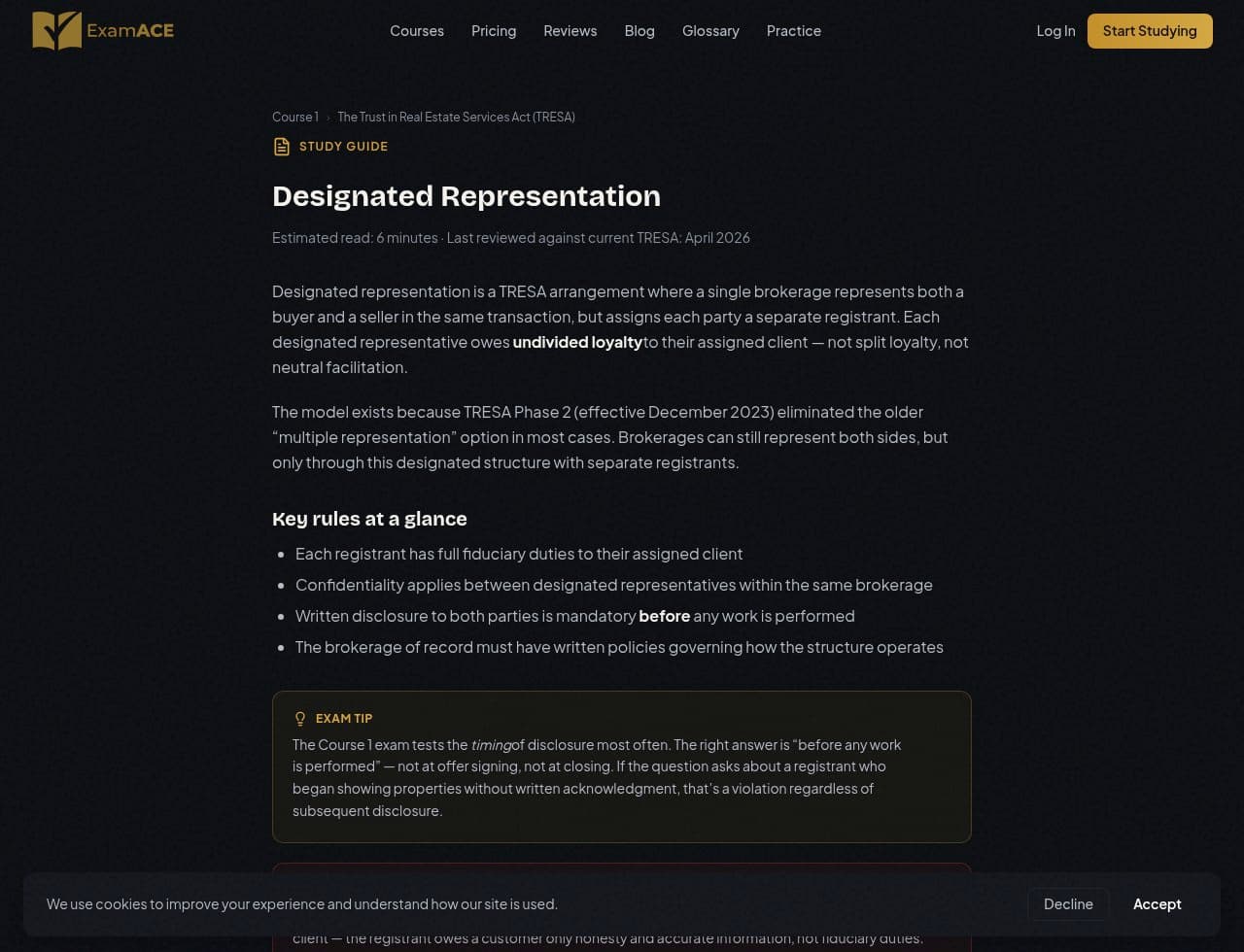
Buyer and Seller Representation
Duties and obligations when representing buyers or sellers in residential transactions.
Agreement of Purchase and Sale
Completing standard residential APS documents, conditions, and clauses.
Showing Properties
Best practices for property showings, feedback, and managing client expectations.
Multiple Offer Situations
Procedures and ethics when competing offers are present.
Closing the Transaction
Steps from accepted offer to closing including title searches and adjustments.
Working with Clients
Building client relationships and understanding their needs and goals.
Why ExamAce for Course 2?
| Feature | ExamAce | Passit |
|---|---|---|
| Access | All 26 courses with one plan, cancel anytime. | Access window of 6–10 weeks per course. |
| AI tutor | Ask why any answer is wrong and get an instant explanation. | No AI tutor, static explanations only. |
| Spaced repetition | SM-2 algorithm resurfaces your weak questions automatically. | No spaced repetition system. |
| Price | $29.99/mo or $129/6mo, all 26 courses. | ~$43/mo per course on a per-course window. |
“Built from the official RECO competency framework and aligned to the Humber College curriculum. Every question reviewed through 7 QA passes against current Ontario statutes.”
What students say
“I passed Course 1 on my first try with a 92%. The spaced repetition feature was a game-changer, I knew exactly what to study each day instead of re-reading the whole textbook.”
“The AI tutor explained TRESA concepts better than my textbook did. Every time I got a question wrong it told me exactly why, and pointed me to the section that tested it. Worth every penny.”
“I had an exam the next day and panicked. ExamAce’s practice mode let me hammer 150 questions in two hours and the explanations stuck. Walked out of Humber knowing I’d passed before I saw the score.”
“Tried Passit first. The 6-week access window stressed me out — I was rushing through instead of actually learning. ExamAce’s monthly subscription let me slow down and re-tackle weak topics. Passed first try with 88%.”
“Math was always my weak spot. The progress dashboard showed me where I was losing points and the spaced repetition kept those questions in front of me until I didn’t miss them. Worth every cent.”
“I’m a slow studier and I worried I’d run out of time on the timed simulator. Practiced timed exams 4 weeks straight before my Course 1. Showed up calm, finished with 30 minutes to spare. Highly recommend.”
Real students
Hear from Humber real estate students
10-second stories from students using ExamAce to prepare for the Humber program.
Frequently asked questions
How many practice questions are in the Course 2 study guide?
The Course 2 guide includes over 770 practice questions, organized by topic and available in a timed exam simulator mode that mimics the real 100-question exam format.
Does ExamAce cover the actual Humber Course 2 exam format?
Yes. Questions are written to match the difficulty and style of the Humber College Course 2 exam, targeting the 75% passing threshold. The exam simulator replicates the timed, multiple-choice format you will face on exam day.
Can I access the Course 2 guide on my phone?
Yes. ExamAce is a progressive web app (PWA) that works on any device, iPhone, Android, tablet, or desktop. You can download it to your home screen for offline access so you can study anywhere, even without a connection.
Studying for the exam? Read the Course 2 exam study guide — exam format, high-yield topics, and common traps.
Start studying for Course 2 today
All 26 courses included. Cancel anytime.
or $129/6mo, saves $51 vs monthly
Buy Now